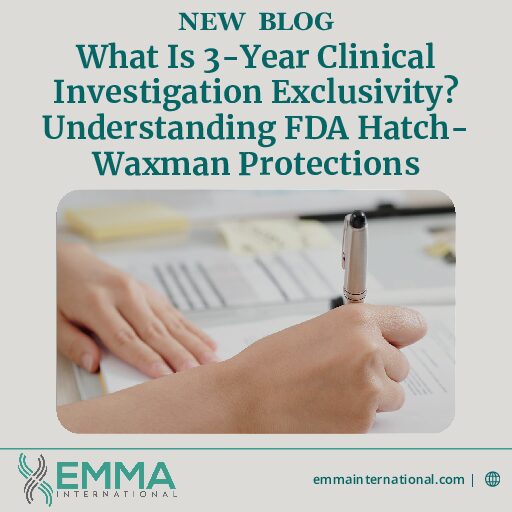
The U.S. Food and Drug Administration (FDA) has released new draft guidance clarifying how sponsors can qualify for three years of marketing exclusivity under the Hatch-Waxman Amendments. The guidance provides additional detail on the clinical investigation requirements that must be met for new drug applications (NDAs) or supplemental NDAs (sNDAs) seeking exclusivity.
For pharmaceutical developers, this clarification highlights the growing importance of strategic clinical development planning. As competition intensifies and regulatory expectations evolve, understanding how exclusivity pathways function can play a critical role in maximizing market opportunity and protecting innovation.
Understanding the Three-Year Exclusivity Framework
The Hatch-Waxman Act established several exclusivity provisions designed to balance pharmaceutical innovation with generic competition. One of these provisions grants three years of marketing exclusivity to certain new drugs or supplemental applications that rely on new clinical investigations essential to approval.
During this exclusivity period, the FDA cannot approve abbreviated new drug applications (ANDAs) that rely on the protected data. This temporary market protection can provide meaningful commercial advantage for sponsors introducing new indications, formulations, or patient populations.
To qualify, the clinical investigations supporting the application must meet several key criteria. The studies must be conducted in humans, must not simply replicate existing data relied upon for previously approved products, and must be essential to the FDA’s determination of safety or effectiveness.
What the Draft Guidance Clarifies
The FDA’s draft guidance takes the form of a question-and-answer document intended to provide additional transparency around the agency’s interpretation of exclusivity requirements.
One important clarification involves the types of clinical studies that may qualify. While bioavailability studies alone generally do not meet the criteria, other non-bioavailability clinical investigations may qualify if they are essential to the product’s approval.
The agency also noted that the clinical investigation does not necessarily have to use the exact final version of the approved drug product. In certain cases, earlier formulations or closely related versions containing the same active moiety may support exclusivity eligibility if the statutory requirements are met.
At the same time, the FDA emphasized that studies involving only placebo administration would generally not be considered qualifying clinical investigations for exclusivity purposes.
Documentation and Evidence Expectations
Sponsors seeking three-year exclusivity must provide specific documentation within their application. This includes certification that the submitted studies meet the criteria for new clinical investigations and that the results were not previously relied upon by the FDA in approving another drug product.
Applicants must also demonstrate that they conducted a comprehensive review of existing scientific literature and explain why previously published studies are insufficient for evaluating the safety or effectiveness of the product under review.
These documentation requirements reinforce the agency’s expectation that sponsors proactively establish the scientific and regulatory rationale for exclusivity claims during the development process.
Why Regulatory Strategy Matters in Exclusivity Planning
Exclusivity provisions remain a critical component of pharmaceutical lifecycle strategy. However, qualifying for these protections requires careful alignment between clinical development plans, regulatory submissions, and supporting scientific evidence.
Sponsors must ensure that clinical investigations are designed not only to support approval but also to meet the specific statutory requirements associated with exclusivity eligibility.
At EMMA International, we work with organizations across life sciences and regulated industries to build structured regulatory strategies that support product development, market entry, and lifecycle management. By integrating regulatory planning early in development, organizations can reduce uncertainty, strengthen submissions, and maximize the value of regulatory pathways such as marketing exclusivity.
For more information on how EMMA International can assist, visit www.emmainternational.com or contact us at (248) 987-4497 or info@emmainternational.com.
Reference:
U.S. Food and Drug Administration. (2026, March 4). Draft Guidance: Clinical Investigations Supporting Three-Year Exclusivity for New Drugs.
Regulatory Affairs Professionals Society. (2026). FDA drafts guidance explaining three-year clinical investigation exclusivity for new drugs.
U.S. Congress. (1984). Drug Price Competition and Patent Term Restoration Act (Hatch-Waxman Amendments).
U.S. Food and Drug Administration. Guidance for Industry: Marketing Exclusivity Provisions.