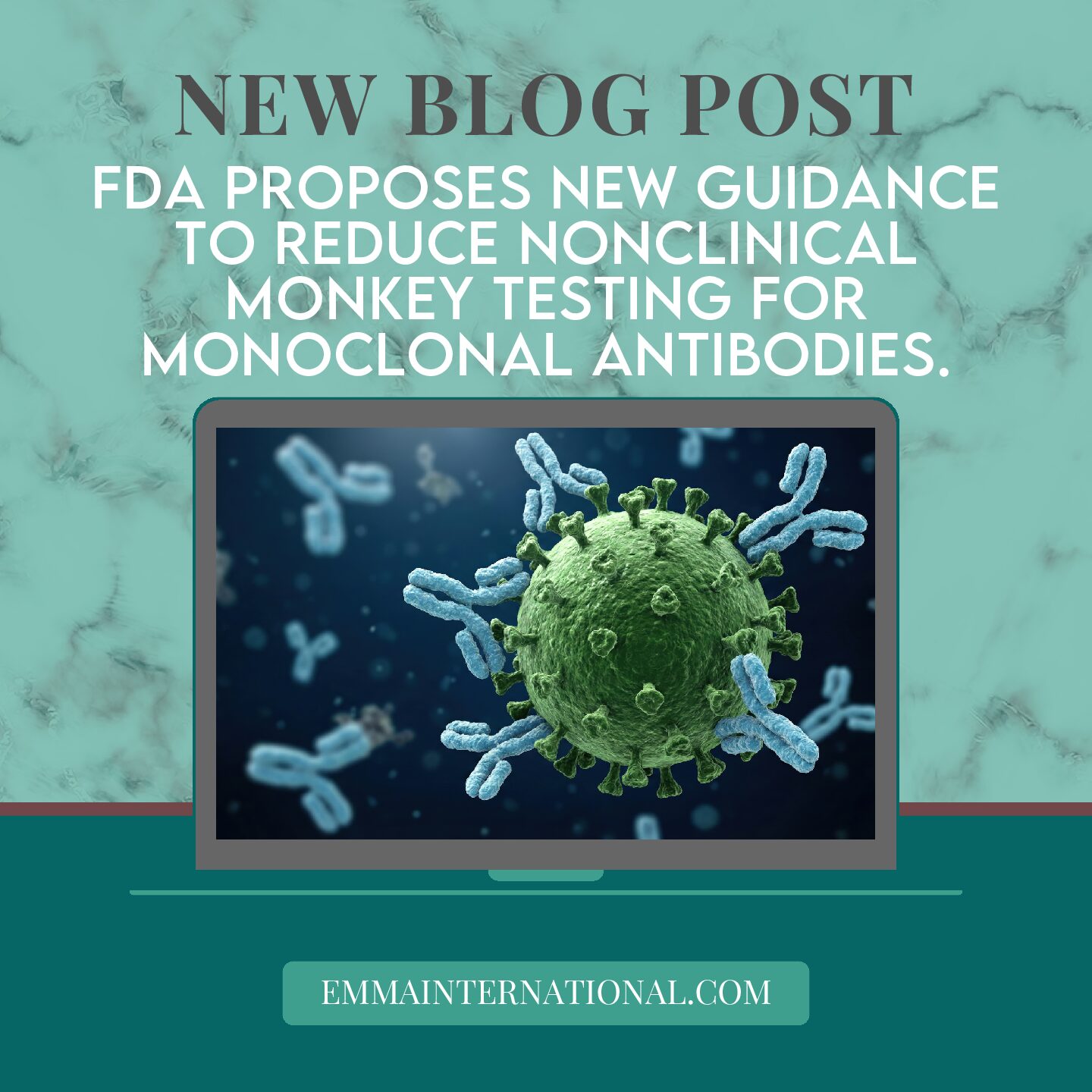
The U.S. Food and Drug Administration (FDA) has released new draft guidance that could significantly reduce the reliance on non-human primates in safety testing for monospecific monoclonal antibodies. The document, Monoclonal Antibodies: Streamlined Nonclinical Safety Studies, outlines ways sponsors can assess long-term safety using shorter studies, alternative models, or in some cases no animal testing at all.
The guidance focuses exclusively on monospecific antibodies, excluding multispecific constructs, antibody-drug conjugates, and similar complex modalities. According to the FDA, the goal is to modernize nonclinical testing and promote more humane methods while maintaining scientific rigor.
A Shift Toward Risk-Based, Knowledge-Driven Assessments
Unlike small molecules, monospecific antibodies are not metabolized through hepatic pathways, which means traditional metabolite toxicity concerns generally do not apply. The FDA noted that understanding target biology, pharmacology, and expression patterns can guide safety predictions without requiring extended animal studies.
Under the draft guidance, chronic toxicology studies in monkeys, dogs, or mini pigs should typically be limited to three months. Sponsors may also determine that long-term studies are unnecessary if a weight-of-evidence assessment demonstrates that human safety can be adequately predicted through other means.
FDA highlighted several types of information that may support this approach, including clinical pharmacokinetics, prior human safety data for similar products, literature on target-related toxicities, and newer nonclinical technologies such as transgenic models and in vitro systems. The agency encouraged early discussion with review divisions before sponsors commit to a testing strategy.
When Longer or No Studies May Be Needed
While the FDA expects most programs to move toward streamlined testing, there may be instances where a three-month study is insufficient. Examples include products intended for long-term continuous dosing or cases where existing data raise questions about potential toxicities.
Conversely, the agency acknowledged that for certain antibodies, no animal species may be pharmacologically relevant. In these situations, nonclinical animal data may offer limited predictive value, and the FDA may support development pathways that do not require animal toxicology studies.
The draft guidance does not apply to oncology programs, which are governed by separate recommendations designed to provide greater flexibility for cancer therapeutics.
Reducing Animal Use Through Modern Science
The FDA framed the guidance as part of a broader strategy to shift away from traditional animal testing when it is not scientifically necessary. Commissioner Marty Makary stated that expanding the use of human-relevant tools can make drug development more efficient, reduce costs, and accelerate the availability of new therapies.
The FDA noted that a typical monoclonal antibody program can require around 100 macaque monkeys at substantial cost, yet many of these programs fail due to human-specific issues that animal models cannot predict. By integrating computational tools, organoid models, and real-world evidence, the agency hopes to improve both scientific outcomes and ethical standards.
At EMMA International
At EMMA International, we support sponsors as they navigate evolving regulatory expectations for biologics and advanced therapeutics. Our team provides guidance on designing nonclinical and clinical strategies that align with FDA’s risk-based approach, including support for weight-of-evidence assessments, early engagement planning, and documentation to justify streamlined testing programs.
Whether you are preparing for a pre-IND meeting, developing a comprehensive safety package, or adapting to new regulatory pathways that emphasize modern science and reduced animal use, EMMA International offers end-to-end support to keep your program compliant and efficient.
For more information on how EMMA International can assist, visit www.emmainternational.com or contact us at (248) 987-4497 or info@emmainternational.com.
Reference:
Hayes, E. (2025, December 2). FDA guidance would cut back on using monkeys for safety testing of monoclonal antibodies. Regulatory Affairs Professionals Society.
U.S. Food and Drug Administration. (2025). Monoclonal Antibodies: Streamlined Nonclinical Safety Studies.
U.S. Food and Drug Administration. (2025). Federal Register Notice: Nonclinical Safety Assessment Approaches for Monoclonal Antibodies.