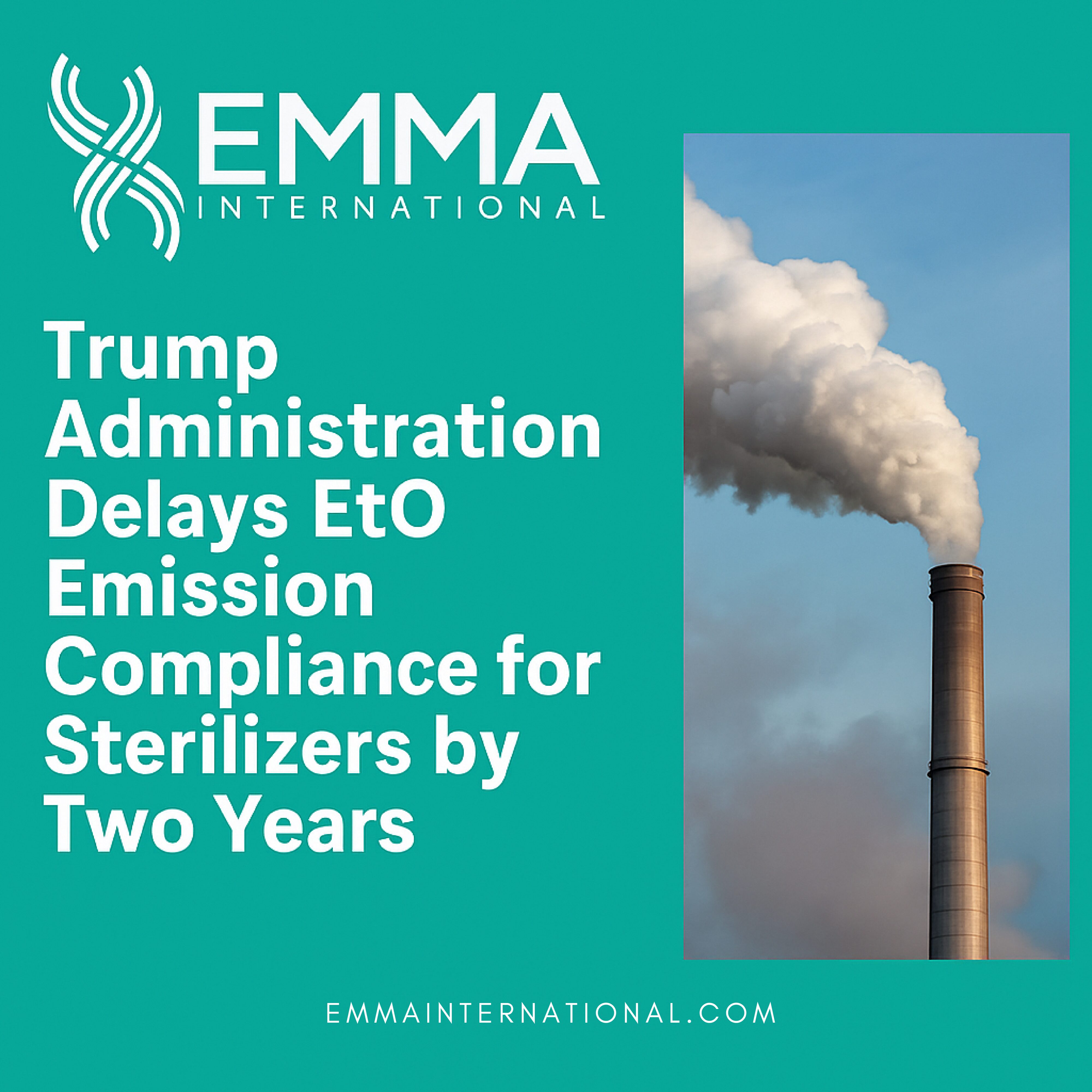
On July 21, 2025, President Donald Trump issued an executive order granting medical device sterilization facilities an additional two years to comply with the Environmental Protection Agency’s (EPA) limits on ethylene oxide (EtO) emissions. This move delays the original April 2026 compliance deadline and is intended to prevent potential shortages of sterile medical devices while acknowledging current limitations in emission control technology.
EtO is commonly used to sterilize approximately half of all medical devices in the United States. Many of these devices—such as catheters, endoscopes, IV sets, and surgical kits—are difficult or impossible to sterilize with alternative methods without compromising product integrity. However, EtO is classified as a carcinogen, and the EPA’s final rule, issued in March 2024, set new National Emission Standards for Hazardous Air Pollutants (NESHAP) to reduce exposure risks from commercial sterilization operations.
Executive Order Cites Technology Gaps and Supply Chain Risks
The executive order cites significant challenges faced by device sterilizers in implementing the EPA’s requirements. According to the order, the equipment and technology needed to meet the new EtO emission standards are not commercially available at the scale or speed required.
The administration also argues that enforcing the rule as originally scheduled could compromise national security by jeopardizing the supply of critical medical products. The order identifies 39 sterilization facilities that will be temporarily exempt from the compliance timeline.
“The technology to implement the EtO Rule is not available,” the order states. “Such technology does not exist in a commercially viable form sufficient to allow implementation and compliance with the EtO Rule by the compliance dates.”
Industry and Regulatory Reactions
Industry stakeholders had long raised concerns about the feasibility of the original EPA rule. Scott Whitaker, president of the Advanced Medical Technology Association (AdvaMed), previously criticized the EPA for underestimating the time and infrastructure needed to comply. He also questioned whether the health risks associated with EtO were being overstated.
The FDA also acknowledged the potential public health impact of the rule, especially in rural or underserved areas where device availability is already strained. During a 2024 Food and Drug Law Institute (FDLI) meeting, FDA officials expressed concern that premature enforcement of the EtO limits could create shortages of sterilized devices essential for patient care.
Support from Device Manufacturers
Becton Dickinson (BD), a major sterilization provider with multiple facilities named in the executive order, voiced support for the extension. In a public statement, the company emphasized its commitment to compliance but noted delays in the availability of required equipment.
“Some of the new provisions require new equipment that is manufactured by a limited number of manufacturers and may not be available in time to install and test before the original April 2026 deadline,” BD stated.
BD also referenced data collected by the Georgia Environmental Protection Division in 2022, which found EtO levels near its Covington facility to be comparable to those in remote locations with no known industrial sources of the chemical.
Balancing Risk, Regulation, and Access
The two-year delay underscores the ongoing tension between environmental protection efforts and medical product access. While reducing EtO exposure remains a long-term goal, this executive order represents a temporary compromise to ensure continuity of care while allowing more time for industry adaptation.
At EMMA International, we help device manufacturers navigate complex regulatory landscapes, including environmental compliance, sterilization standards, and FDA communication. As the requirements surrounding EtO emissions evolve, timely guidance and compliance strategy are essential to maintaining market access and operational continuity.
For more information on how EMMA International can assist, visit www.emmainternational.com. Contact EMMA International at (248) 987-4497 or by email at info@emmainternational.com to learn more.
References
Eglovitch, J. (2025, July 21). Trump gives device sterilizers two more years to comply with EtO limits. Regulatory News.