Artificial intelligence (AI) is rapidly shifting from a transformative technology to a field with increasingly defined legal expectations. Around the world, regulators are transitioning from high-level principles to enforceable requirements that affect how companies develop, deploy, monitor, and govern AI systems — especially when those systems influence safety, fairness, transparency, or individual rights.
For businesses across technology, fintech, life sciences, and other regulated industries, staying ahead of AI regulatory developments isn’t just about avoiding penalties — it’s about maintaining trust, ensuring product integrity, and supporting sustainable innovation. In this evolving environment, a structured regulatory strategy is critical to turning compliance into competitive advantage.
High-Risk AI Obligations Are Coming Into Force
One of the most significant global developments in AI policy is the EU’s Artificial Intelligence Act, which entered into force in 2024 and continues phased implementation through 2026 and beyond. The Act adopts a risk-based framework that defines obligations based on potential impact — with “high-risk” systems subject to extensive governance, documentation, transparency, and accountability requirements.
Companies that develop or deploy AI tools in areas such as recruitment, healthcare decisions, credit scoring, or automotive safety may fall into this high-risk category. For these products, regulators expect:
- Risk management systems
- High-quality, unbiased training data
- Technical documentation and logging
- Human oversight and transparency
- Robust cybersecurity measures
By August 2, 2026, many of these requirements will be enforceable — and failure to comply may carry significant penalties and restrictions.
U.S. State AI Laws Drive Localized Compliance
Unlike the EU, the United States has not yet enacted a single federal AI statute. Instead, several state-level AI laws are taking effect in 2026, each with unique compliance obligations that companies must account for if they operate or market AI systems within those states.
For example:
- Colorado’s AI Act requires risk mitigation programs and documentation to address algorithmic discrimination.
- Utah’s Artificial Intelligence Policy Act (SB 149) mandates transparency and consumer disclosures when AI interacts with users.
This state-by-state approach creates a patchwork of regulatory obligations, making compliance planning far more complex than a single jurisdiction strategy.
Beyond AI Laws: Global Shifts in Governance Approach
Internationally, other markets are strengthening AI regulations as well. For instance:
- South Korea’s new AI laws — effective January 22, 2026 — require risk management plans and human oversight for high-impact systems in areas such as transportation, healthcare, and financial screening.
This global momentum reinforces a broader trend: regulators are no longer debating whether AI needs oversight — they are defining what it looks like in practice.
Why This Matters for Your Organization
As AI applications move into operational systems across regulated industries — from fintech payment platforms to clinical decision support tools — organizations must be prepared to:
- Conduct AI risk and impact assessments aligned with regulatory expectations
- Build robust documentation and governance practices into development lifecycles
- Demonstrate human oversight and accountability mechanisms
- Maintain audit-ready compliance artifacts for regulators and stakeholders
Failure to prepare can result in slower releases, enforcement actions, diminished market trust, and competitive disadvantage.
How EMMA International Supports AI Regulatory and Governance Readiness
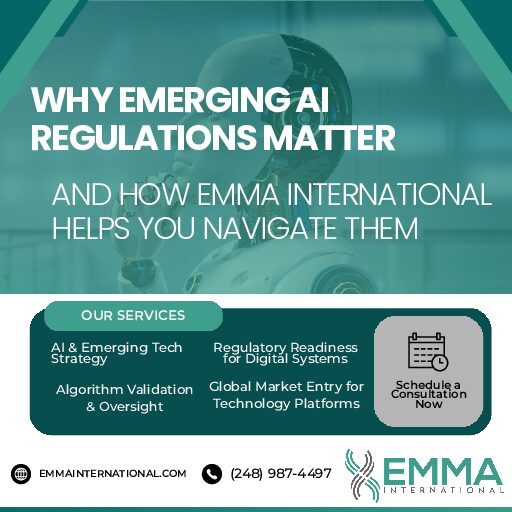
At EMMA International, we help clients translate emerging AI regulatory expectations into operational readiness and strategic compliance.
Our approach includes:
- AI regulatory roadmap development that aligns with EU, U.S., and global frameworks
- Risk assessment and documentation strategy to support high-risk AI system oversight
- Governance framework design that integrates AI policies with existing quality and compliance programs
- Audit readiness support to ensure organizations can demonstrate control and transparency when required
As AI regulatory regimes mature, organizations with structured governance and quality systems will be best prepared to meet those expectations — and to innovate with confidence.
For more information on how EMMA International can assist, visit www.emmainternational.com or contact us at (248) 987-4497 or info@emmainternational.com.
Reference:
EU AI Act risk-based obligations and phased compliance deadlines (August 2, 2026).
Analysis of state-level AI laws in the U.S. with transparency and risk-management requirements.